Be a Better Grower Newsletter
By Jono Neiger, an agroforestry planner at Regenerative Design Group Cooperative (a small worker-owned design and planning firm in western MA) and owner/operator of Big River Chestnuts, a chestnut agroforestry farm in Sunderland, MA. With Seva Water of Regenerative Design Group and Nutwood Farm.
The following is an abbreviated version of an article published in the Spring issue of The Natural Farmer.

Please check their website for the full version. All NOFA/Mass Members receive a one year subscription to The Natural Farmer.
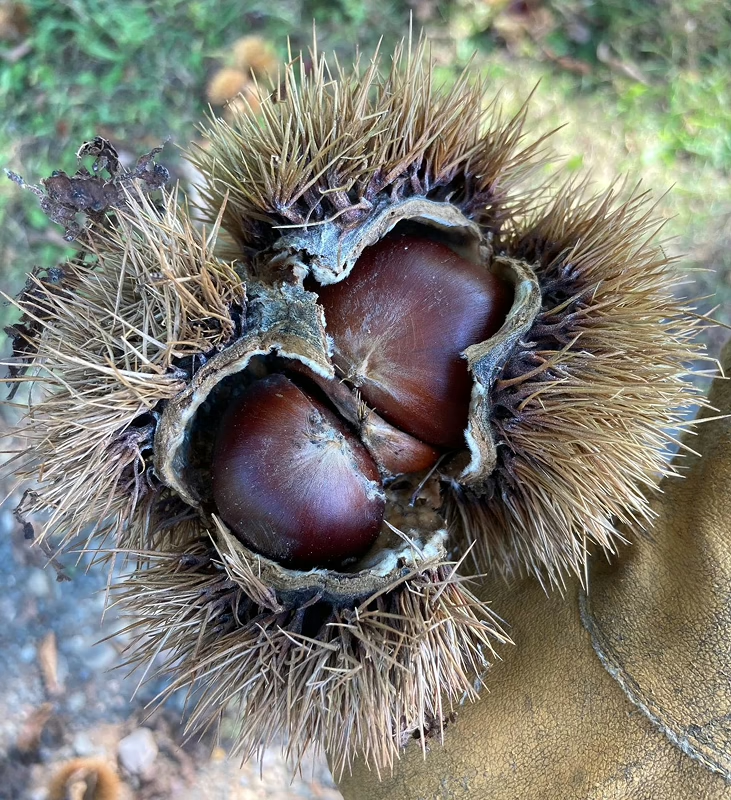
Chestnut bur with nuts
Nut trees are having their day in the sun. Trees are being planted. Processing equipment is being set up. Excitement is high.
Nuts have historically been an important food source; Indigenous peoples have been harvesting hickories, acorns, walnuts, chestnuts, hazelnuts, and others for millennia, but in the last few generations, with the rise of monocrop and annual agriculture, tree-based systems have largely been left behind. Commercial nut production has narrowed to a few crops: almonds, pistachios and walnuts in California, pecans in the South, and hazelnuts in the Northwest.
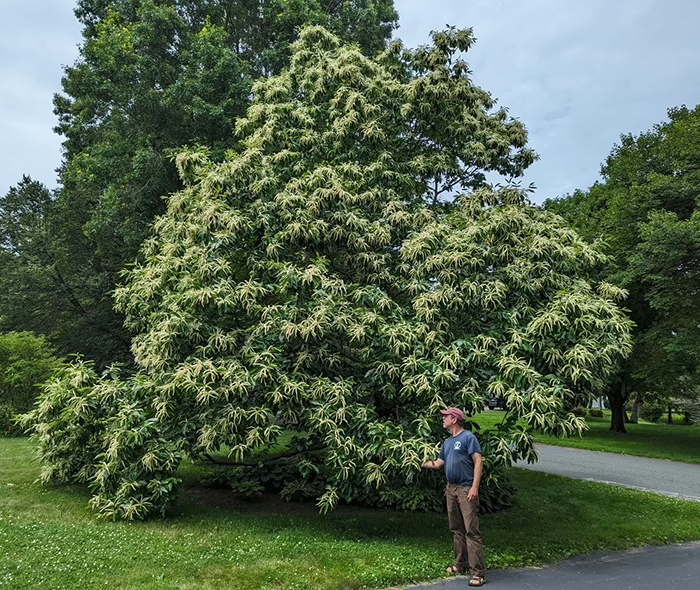
Chestnut tree in flower
In the Northeast US, we live in a forested landscape, with trees everywhere. Creating an agriculture of and about forests is very natural. The present Northeast growing conditions of sloped land, thin soils, short growing season, and (often) good rainfall make tree growing, and nut tree growing make sense.
Trees fit well within integrated cropping systems, such as agroforestry, including silvopasture, riparian buffer plantings, understory forest farming, alley cropping, and other crops between trees, as well as windbreaks. Nuts can grow in monocrop orchard layouts, but benefits increase when they are combined with other crops and overlapping functions. For example, chickens and small fruits can be grown under and around nut trees until they reach maturity and begin bearing. Numerous resources are becoming available to new growers through organizations such as NOFA, CISA, Regenerative Design Group, American Farmland Trust, and Mycena Agroforestry, and through agencies such as NRCS, which are actively funding some agroforestry practices.
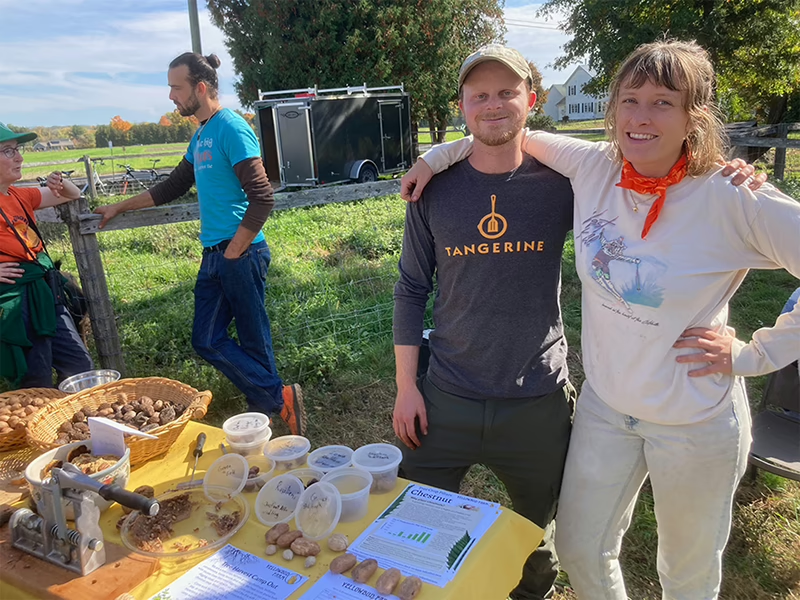
Nut display
Nuts for Commercial Production
I tend to classify nut crops into one of three categories based on their readiness for commercial-scale production.
‘Best Bets’: These crops have established genetics, processing systems, and ready markets with product recognition.
Moderately Ready: These crops are close to the ‘best bets’ level but still face challenges, often in processing, markets, or public familiarity.
In Development: These are crops that many of us growers would love to see integrated into the food system, but still require breeding, infrastructure, or cultural adoption.
‘Best Bets’
Chestnuts (Castanea mollissima is a blight-resistant variety)
Nutritious, delicious, and a hardy, long-lived tree, chestnuts are making a comeback on our farms and in our kitchens. Bearing age chestnut acres in the US doubled from 2,185 acres in 2017 to 4,419 acres in 2022. Almost 6,000 total acres have been planted, and could replace some of the 6-7 million pounds of imported chestnuts sold in the US. Imported nuts are often improperly stored and of lower quality. The larger domestic supply will likely drive increased offerings of value-added products. Demand for chestnut flour is growing rapidly as consumers learn to cook with this gluten-free alternative, as well as chestnut crème and dried and chipped nuts.
Chestnut trees have three main needs: full sun, well-drained, and acidic soils. Several decades of selecting cultivars and complex cross-species hybrids mean there are high-quality trees ready to go that bear quickly (5-7 years for substantial yields) and produce high-quality nuts year after year. Growers usually plant seedlings from select mother trees to avoid a delayed graft failure syndrome. Once mature, trees yield 1000-1500 lbs per acre per year, with much higher yields sometimes reported.
Hazelnuts
Another prime-time nut, which grows as a multi-stem shrub, is the hazelnut. Breeding and cultivar selection in the East, centered at Rutgers University with Tom Molnar, has led to improved hybrids (american x european) with larger-sized nuts. Other breeders, such as Jeff Zarnowski at Z’s Nutty Ridge in Central NY, are pushing the envelope with improved, disease-resistant hybrid selections. Hazelnuts are super-hardy and can handle tough growing conditions, though they need full sun and some protection from rodents.
A significant challenge for this crop is the cost and acquisition of processing equipment to separate the nut from the shell, husk, sort, size, and press. This conundrum has tremendously slowed the growth of this promising nut. In response, the New York Tree Crop Alliance has used grant funding to install small-scale processing equipment at its new facility in Cortland, NY.
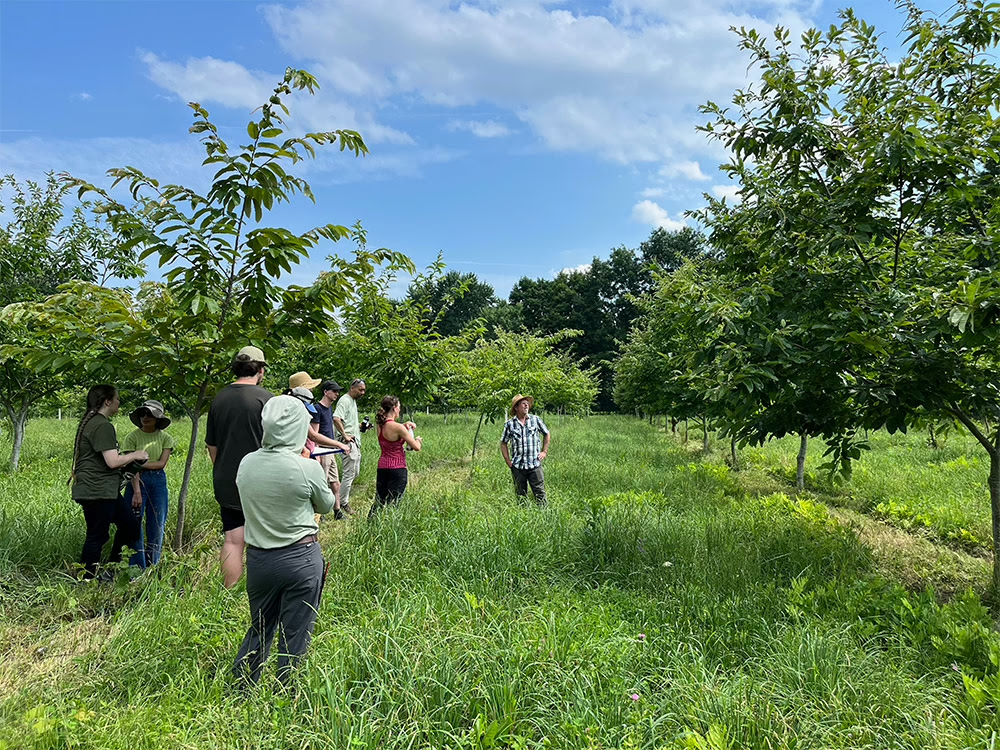
Jono leading a tour at Big River Chestnuts
|
||
|
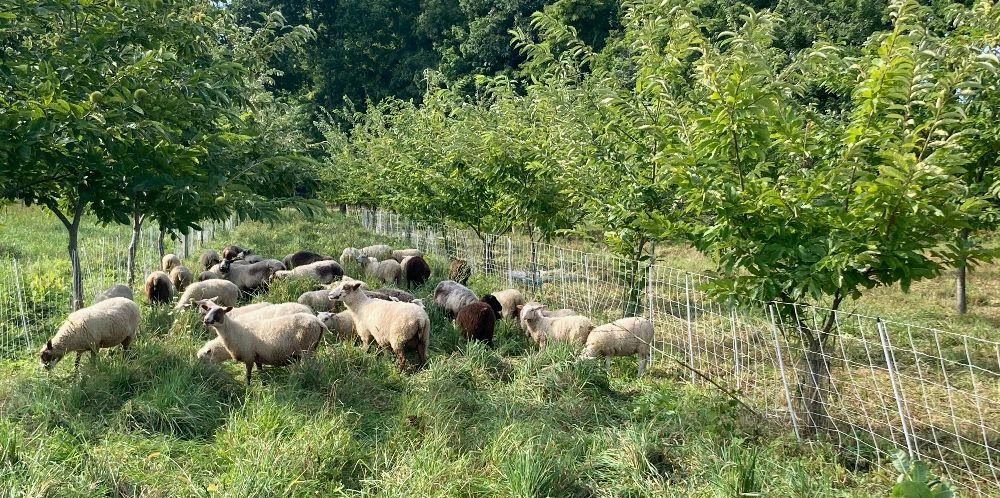
Silvopasture at Big River Chestnuts
More about Big River Chestnuts, chestnut agroforestry in western MA:
Big River Chestnuts illustrates both the promise and the challenges of growing nut trees in the Northeast. In 2018, we planted seedling Chinese chestnuts (Castanea mollissima x), primarily from Rt 9 Cooperative in Ohio, and some grafted European x Japanese crosses. We started a seasonal market in the fall of 2019 to learn about the potential of the local market, and easily sold out of all the fresh nuts we could harvest and buy in from other growers. We are investing in the equipment to process larger volumes and develop a value-added processing line.
Since then, we added 5 more acres in Easthampton, MA, and 67 acres in South Deerfield. While primarily chestnuts, we also included small fruits such as aronia, elderberry, and black currant. We also have smaller plantings of hazelnut (250 bushes), heartnut (12 trees), oaks (15 trees), and walnuts (20 trees). The crops are integrated into agroforestry systems to provide an early crop while we wait for later-bearing trees to start producing. We planted with varying tree spacings to allow for more intercropping (alley cropping) and livestock grazing underneath (silvopasture). For the last three years, we have collaborated with Matt Kaminsky and Rachel Haas of Meadowfed Lamb to graze their sheep under our trees. The benefits to both the orchard and the animals are beyond a shadow of a doubt.


Farmer Article
by Richard Robinson of Hopestill Farm
Two tips for growing spinach seedlings
We start spinach indoors in January for early transplanting into our unheated hoophouses in February. Here are two tips we’ve found that really help get our seeds to sprout, and keep them healthy while growing under lights.
Sanitize your trays
Like other members of the Amaranthaceae (including beets and chard), spinach seedlings are highly susceptible to damping off fungus. We’ve tried a few approaches, including Rootshield, but have found the most reliable preventive measure is sanitizing our 1020 trays with bleach.
We begin by scrubbing any dirt from the tray, and rinsing with water. Then, in a large pail, we mix one part household bleach with nine parts water, and pour about half an inch into each tray. We scrub the tray lightly, then let it sit for 10 minutes, before dumping and rinsing with water. Once the tray is dry, it is ready to plant.
Prime your seed
Germination of spinach can be slow and variable. A few seeds in a tray might come up in the first week, with more following a week later, and some laggards waiting a month or more. We’ve found we can get faster and more complete germination by priming the seed before sowing it.
We soak the seed in unchlorinated water for 24 hours, then let it dry on paper towels. Once dry, we put it in a sealed container in the refrigerator for 5 days (some folks report good results just from soaking overnight). Once the seed is ready, we sow in 1.5” soil blocks, one seed per block, and cover the tray with a plastic dome. We take the dome off once about half the seeds have sprouted, and keep a fan going in the seed room (6×12 room with 4 shelves, under LED and fluorescent shop lights, heated only by the lights, achieving about 60 degrees this time of year) until we take them out to transplant.
Happy Growing!