Be a Better Grower Newsletter
By Tevis Robertson-Goldberg
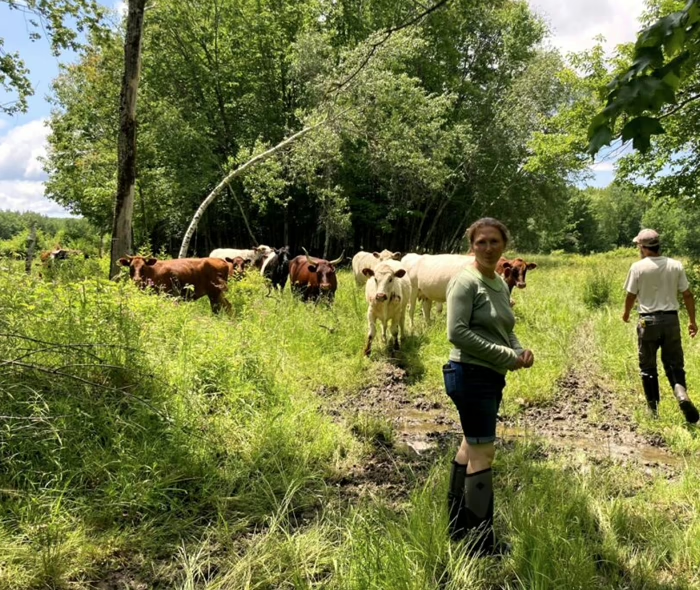
Photo credit: Regenerative Design Group
My wife Rachel and I farm in the hilltowns of western Massachusetts, where we have raised a bit of just about everything over the past twenty years. We mainly produce vegetables, plants, eggs, beef, and lamb, which we sell at farmers’ markets in Northampton and Pittsfield.
Since coming to this land over twenty years ago, we have been working to establish the best system of farming for this particular spot, one that balances the ecological aspect with the need for economic viability. Unlike the fertile soils of the nearby Connecticut River Valley, our sloping land, where the soils are stone-heavy, and slow to drain, isn’t ideal for row crops. Most of our open land is used for pasture and hay; the smaller, more intensively managed portion—where we grow vegetables in the field and manage greenhouses—is what supports most of the farm’s income.
Agroforestry, or integrating trees with row crops and/or animal production, holds great promise and has always been attractive to me. We live in a naturally forested landscape, and basing a farming system entirely on annual crops doesn’t feel like the best solution. In theory, agroforestry improves both ecology and economic sustainability. It can increase biodiversity above ground and below the soil, sequester carbon, and—if done right—agroforestry practices yield more per acre than annual crops alone, by layering production. Agroforestry takes many forms, and honestly, the definition gets fuzzy around the edges. Hedgerows, windbreaks, shade trees in pasture, silvopasture, and alley cropping can be lumped together as agroforestry. And to some extent, we’re doing all of those on our farm.
Step by Step – Working with what we have
Around all of our fields, we have trees and shrubs forming windbreaks and hedgerows, which offer shade and extra forage for the livestock, while a few pastures include shade trees, like wild apples, dropping treats for the animals in the fall. We also have a lightly wooded area we’ve fenced in to give our cattle a shady place in summer and shelter from wind in winter. Much of this constitutes what I’d call “passive agroforestry” – utilizing the mixed fields and forest landscape of New England to best advantage: we didn’t plant all those trees, we’re just managing around them in a way that allows them to persist. That said, we have planted a few apple trees in the pasture. Some are finally getting large enough to provide shade and drop fruit. Many didn’t make it—voles and rabbits girdled them over winter. Before we plant more, we’ll need to come up with better tree protectors to improve survival, especially in those lower-management zones.
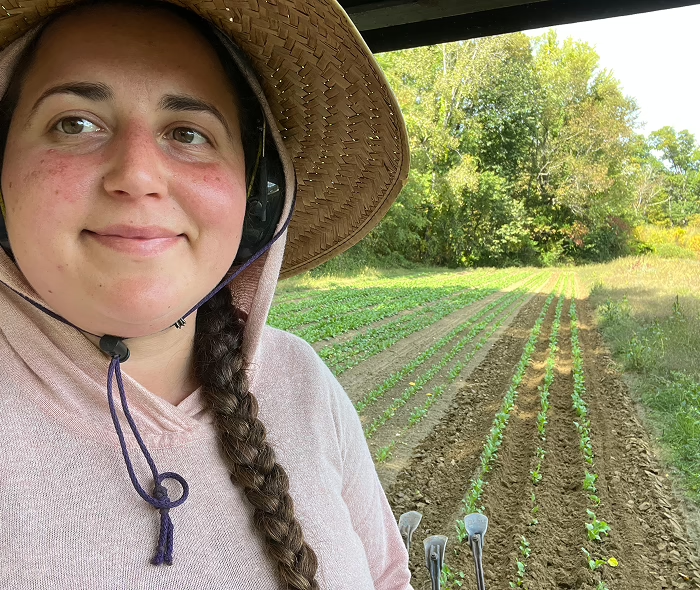
In our vegetable field, where we manage more intensively, we’re trying a more deliberate form of agroforestry: alley cropping. We’ve been planting rows of fruit trees and bushes between blocks of vegetables. These tree rows help slow erosion and water runoff on our sloped ground, and in a few more years, they should start yielding crops for market.
Unlike in a traditional orchard, where spacing and pruning decisions are made to optimize production from the trees, alley cropping systems look to also produce crops in the understory. In our case, the understory crop (vegetables) is our main focus in that field, and we can’t let the trees compete too much. We’ve spaced the rows 50 feet apart—enough to fit eight 5-foot vegetable beds between them. But now that the trees are growing, some are crowding the edges of the vegetable beds.
I’m considering a trellis system to encourage more upright growth. Elderberries in particular fall over under the weight of fruit. Some of our dwarf apple trees are also leaning and need staking. Since we cultivate with a tractor, I’ve been pruning back low branches to keep paths clear. Eventually, I may need to go full espalier to maintain both vegetable production and tree health at this spacing. There’s still a lot of trial and error in figuring out how effectively we can integrate trees and vegetables.
Why isn’t everyone doing this?
One of the most commonly talked about forms of agroforestry is planting nut or fruit trees into pasture. These systems aim to produce a marketable crop while integrating with livestock. Some farmers use trees like apples, persimmons (or honey locusts with their sweet, protein-rich pods) as direct fodder— letting animals harvest and graze the fruit themselves. Others are planting tree crops for human consumption into pasture, or grazing livestock through existing orchards. Chestnuts and hazelnuts, in particular, are often promoted as alternatives to corn and soy, with the potential to reshape the Midwestern landscape and address many environmental challenges.
It sounds great right? But after years of thinking about it, I see several barriers—for myself and for other commercial farmers. First, there’s the time delay. Trees take years—sometimes decades—to reach maturity. The upfront investment is high, and economic returns are far off, if they come at all. Grass, in contrast, provides immediate, renewable feed for animals and can be stored as hay. And while haying is a lot of work, the tools and methods are well established.
Second, there aren’t many established, working models to learn from. Most farms practicing agroforestry are still experimenting. That’s exciting—but it also means that widespread adoption may have to wait until results are clearer.
Another issue is markets and processing. While some crops, like apples, are familiar, many agroforestry crops are niche – take chestnuts, hazelnuts, black walnuts, persimmons or mulberries – and will take more exposure for people to start eating regularly. Some require processing—like shelling or making nut butters—which raises the bar for investment even higher. On top of it all, marketing them takes time, effort, and infrastructure which is a huge demand for small farms.
There are also practical, on-the-ground challenges. For instance, I cut most of my pastures for hay in rotation with grazing. Trees, though they may improve the pasture, would get in the way of haying equipment, which is designed for open fields.
Then there’s food safety. If you’re growing fruit for human consumption, and grazing livestock in the same area, the National Organic Program requires a 90-120 day window between grazing and harvest. That drastically reduces your options for rotational grazing in orchards. We have a small orchard where our chickens roam, but we don’t sell fruit from those trees. It’s too easy to track manure into the picking zone on boots, ladders, and bins. To make it work, you need enough pasture elsewhere to rotate livestock out during the pre-harvest window. And on a small farm, that kind of flexibility can be hard to come by.
There are some grants to help with establishment costs, especially through NRCS. While helpful, those programs can be slow and more recently, unpredictable. I wouldn’t want to build a business plan that is reliant on those grant programs.
What Next?
I’ll keep planting trees and exploring agroforestry where it makes sense. My family enjoys the fruit and shade as much as the animals do, and we’re always finding odd corners of the farm to tuck in a tree or two. I’m not likely to convert whole fields just yet, but I’ll keep experimenting where I can—and staying open to what’s possible.
Tevis and Rachel are farmers in our NOFA/Mass Agroforestry Cohort with Regenerative Design Group, now in its third year of technical assistance and co-learning.